After South Africa's June 30 Deadline Foreigners Hold Their Breath Over Anti-migrant Crisis
Written By
Admin
In this Spotlight story, Rukayat Usman, ADRRC Doctoral Fellow and PhD researcher in Public Policy at the University of Ibadan, examines the aftermath of the June deadline to foreigners in South Africa and lingering fears across African migrant communities.
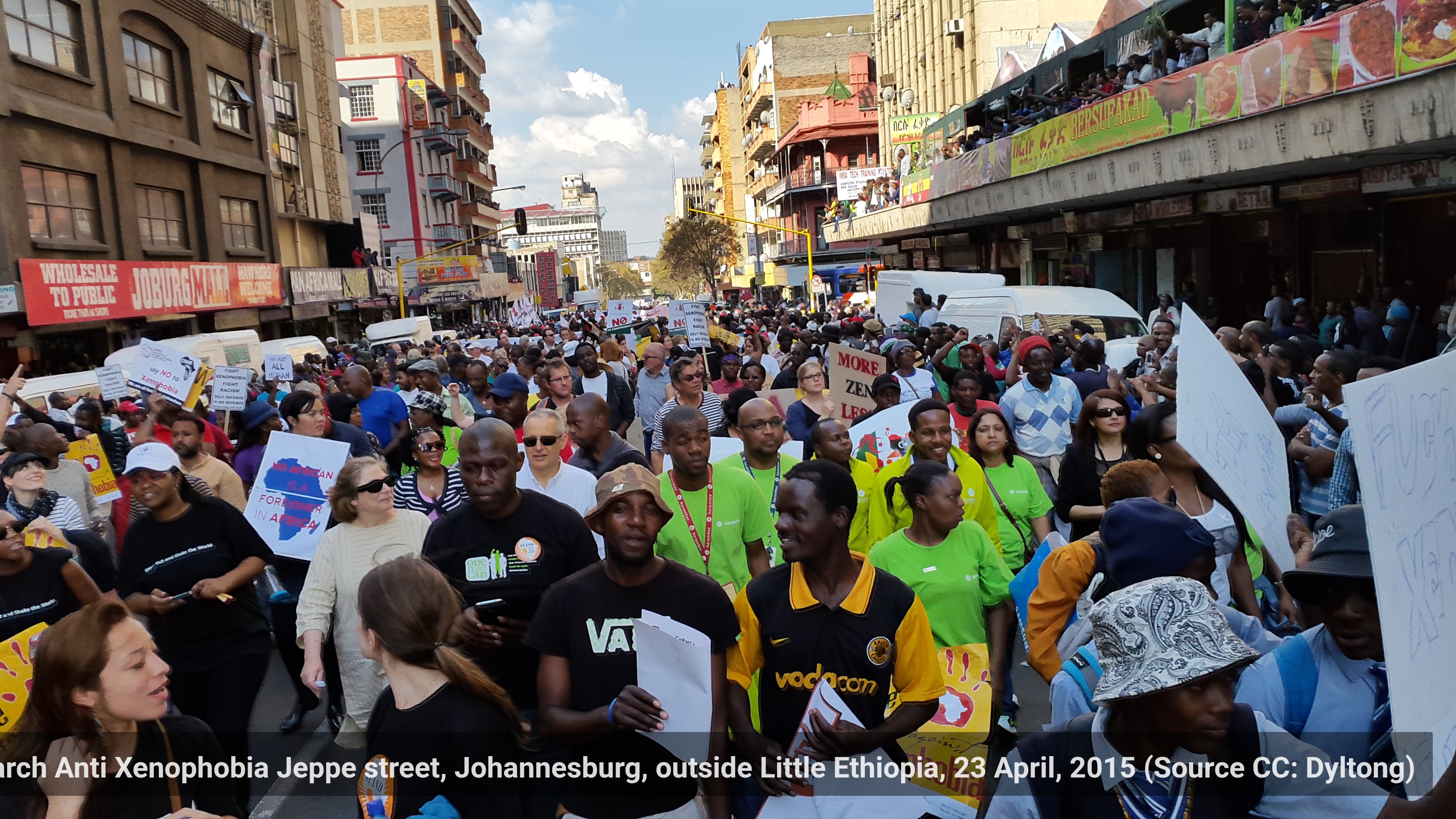
Photo: People's March Anti Xenophobia Jeppe street, Johannesburg, outside Little Ethiopia, 23 April, 2015 (Source CC: Dyltong)
South Africa became the epicentre of a simmering xenophobic storm that precipitated hard mid-2026 as anti-immigrant groups set a dramatic ultimatum — all undocumented foreigners must leave the country by June 30 or face the consequences. What followed was one of the most significant mass displacements of migrants the continent has seen in recent years, triggering international condemnation, mass repatriations, and a tense nationwide standoff.
Origins of the deadline
The June 30 deadline was largely orchestrated by an anti-migrant group called March and March, which until recently remained largely unknown to the broader public. The group set the date as a hard cutoff for undocumented foreigners to leave South Africa, threatening a repeat of the bloody xenophobic riots the country has experienced in the past.
Another key figure was Nkosikhona Ndabandaba, known as "Phakel'umthakathi," who claimed to be the architect of the June 30 deadline. In one widely circulated comments, he announced that "…after Tuesday, I can't control the people of South Africa." Other groups, including Operation Dudula — whose name in Zulu roughly translates as "push back" — also participated in the mobilisation, stopping people on streets to check identification and blocking foreign nationals from accessing public hospitals.
In the weeks leading up to the deadline, thousands fled their homes, sleeping rough in open fields and makeshift camps, lives have been lost with several foreign-owned businesses suffering hard hits. In Durban alone, up to 7,000 foreigners — mainly Malawians — gathered in a single field awaiting repatriation. Similar figures have been recorded for many other African nationals. Police reported that nearly 25,000 undocumented migrants had been repatriated by the time the deadline arrived.
On June 30 itself, thousands of South Africans marched in Johannesburg, Cape Town, and Durban. During demonstrations, looting and property destruction occurred in several neighbourhoods.
The context behind the demands
Anti-immigrant sentiment in South Africa did not emerge in a vacuum. The country has a long history of anti-immigrant violence. Official records on the xenophobic riots in 2008 noted that 62 people were killed and more than 150,000 displaced. Another wave of attacks in 2015 left at least five people dead. Protesters blamed migrants for taking jobs by accepting lower wages, overcrowding schools, straining public hospitals, driving up crime rates and drug peddling. The country faces one of the world's highest unemployment rates, recorded at 32.7% in early 2026, with 350,000 jobs lost in the first quarter alone — the majority affecting young people.
However, experts disputed these claims. According to The Guardian newspaper, the country hosts about 3 million migrants (documented and undocumented). A 2018 World Bank report showed that for every migrant employed, approximately two jobs are created for South Africans through business activity. Research also found that immigrants are "disproportionately law-abiding," with most crimes being immigration violations. According to these reports, migrants constituted only about 4.1% of the population — far lower than comparable nations like Canada (22%) or Australia (30%). Experts noted that anger rooted in unemployment, corruption, and state failure had been redirected toward migrants, with political parties further stoking tensions ahead of local elections scheduled for November 2026.
Who was targeted
The protests were nominally directed at undocumented migrants, but in practice, both documented and undocumented foreign nationals were swept up in the violence and intimidation. Migrants from Malawi, Mozambique, Zimbabwe, DRC, Nigeria, Ghana, and Ethiopia bore the brunt of hostility. Critically, the targeting was racially specific — directed at Black African migrants, while wealthier foreigners and White residents were rarely targeted, causing many to tag the protests as Afrophobic. Even asylum seekers and refugees with valid legal documentation reported being evicted by landlords, attacked in the streets, and chased from their homes.
Governmental and international responses — Nigeria leads the condemnation
Nigeria was among the most vocal critics. The Nigerian Foreign Ministry condemned the deaths of two of its nationals on June 28 — one allegedly killed by police in Pretoria using "gruesome interrogation techniques," and another murdered at his shop in Mpumalanga by unknown attackers. Nigeria has thus far evacuated approximately 600 of its citizens in the weeks surrounding the deadline and announced plans to seek compensation for properties abandoned by returnees.
Ghana summoned South Africa's ambassador after a Ghanaian man was harassed on video, and later delayed planned governmental meetings with Pretoria over the violence. Malawi, Mozambique, Zimbabwe, and Ghana all organised air and bus repatriations for their citizens.
Nigerians – scholars, politicians and concerned citizens - have called for stronger responses from the Nigerian government. Dr. Kudus Adebayo of the ADRRC called on the government to send more planes to repatriate her citizens, and to introduce stronger foreign policy measures to protect its diaspora. He noted, however, that a lot of Nigerians with strong roots and attachments to South Africa would remain there and ignore evacuation. This means that the Nigerian state must continue to pressure the South African government to honour their obligations to all migrants under international and regional laws and principles.
Aftermath
March and March leader Jacinta Ngobese-Zuma declared that protests would continue every Thursday for six months until the government introduces tougher immigration laws. Meanwhile, South African President Cyril Ramaphosa condemned vigilantism and warned that security forces were on high alert, stating that the government hold the exclusive right in handling foreign affairs and national security. In a bid to keep his electorate, he also announced that the government enforcement measures have expanded arrests under the Immigration Act — with over 50,000 undocumented migrants arrested since January 2026.
For many migrants, however, the crisis left deep scars, while those left behind are currently living in fear, with thousands more waiting for repatriation. The June 30 deadline may have passed — but for South Africa's foreign communities, the fear remains very much alive.